
The Enneagram: Your Personality Pattern Shapes the Way You Eat
Most of us try to change our eating, movement, or health habits by sheer willpower—as if the mind alone should override everything else. But the truth is simple and often surprising: Your personality has a direct impact on how you eat, how you move, how you react to stress, and how easy or hard change feels.
When you understand the deeper motivations driving your behavior, something softens. You stop blaming yourself for patterns that feel stubborn. You start recognizing what’s actually happening inside you. And instead of fighting your personality, you begin working with it.
That’s where the Enneagram becomes such a powerful tool.
Why the Enneagram Matters for Eating, Movement, and Change
Each of us learned, early in life, one of nine core strategies for coping with the world. These strategies quietly shape the way we think, relate, plan, defend, avoid, achieve, soothe, and yes—eat.
They operate mostly outside our awareness, which is why even people who are insightful, self-reflective, or have been in therapy for years can still feel pulled into familiar patterns.
The Enneagram doesn’t judge these strategies. It simply shines a light on what’s been running the show.
When you begin seeing your habits through the lens of your personality, you understand:
Why certain eating patterns persist even when you “know better.”
Why change feels natural for some types and overwhelming for others.
Why the same situations trigger you again and again.
Why you can be so capable in one area of life and feel stuck in another.
This clarity makes change feel less like a fight and more like a collaboration with your truest self.
How I Came to the Enneagram
I’ve been interested in personality systems since the 1980s and spent twenty years studying and teaching the Myers-Briggs Type Indicator (MBTI®). But in 2003, I encountered something different—something that changed the way I understood myself, my relationships, and eventually, my work with clients.
At the time, I was struggling with a landlord who seemed to react negatively to everything I said. One day, I vented to a friend, who wondered whether the landlord might be a particular Enneagram type. I scribbled down some notes, went home, and started reading.
What I learned completely shifted the dynamic. By adjusting a few of my own habitual patterns—patterns tied to my type—our interactions changed. For the first time, we got along.
It felt like someone had handed me an instruction manual to human behavior.
Since then, I’ve completed more than 500 hours of in-person Enneagram training, including three year-long teacher trainings. I studied weekly with Enneagram teacher Dr. Lissa Friedman in Gainesville and became a Certified Teacher in the Embodiment Tradition.
Even after all these years, the Enneagram still surprises me with its depth, accuracy, and generosity.
How We Use the Enneagram in Nutrition Therapy
I began doing nutrition therapy in 1983, and very early on I noticed something important:
Two people can receive the same guidance, but their ability to follow through can be dramatically different.
Some leap into change.
Some freeze.
Some rebel.
Some collapse into shame.
Some intellectualize and never act.
Some try to do it perfectly and burn out.
Some lose track of what they want because they’re tuned into everyone else.
When I began using the Enneagram in my work, many of those differences made much more sense. Hannah began studying the Enneagram in 2018 and found the same thing: it can help connect the dots between “I know what to do” and “But I don’t do it.”
And even after all these years, the Enneagram still surprises her with its depth, accuracy, and generosity.
What Exactly Is the Enneagram?
The Enneagram is a system that describes nine core personality types—nine different ways of seeing the world and managing inner emotional life. Each type is organized around specific motivations and fears that influence how we behave, respond, and cope.
The name comes from the Greek:
ennea = nine
gramma = something written or drawn
The symbol itself—a nine-pointed diagram—shows how the types connect, influence, and balance one another.
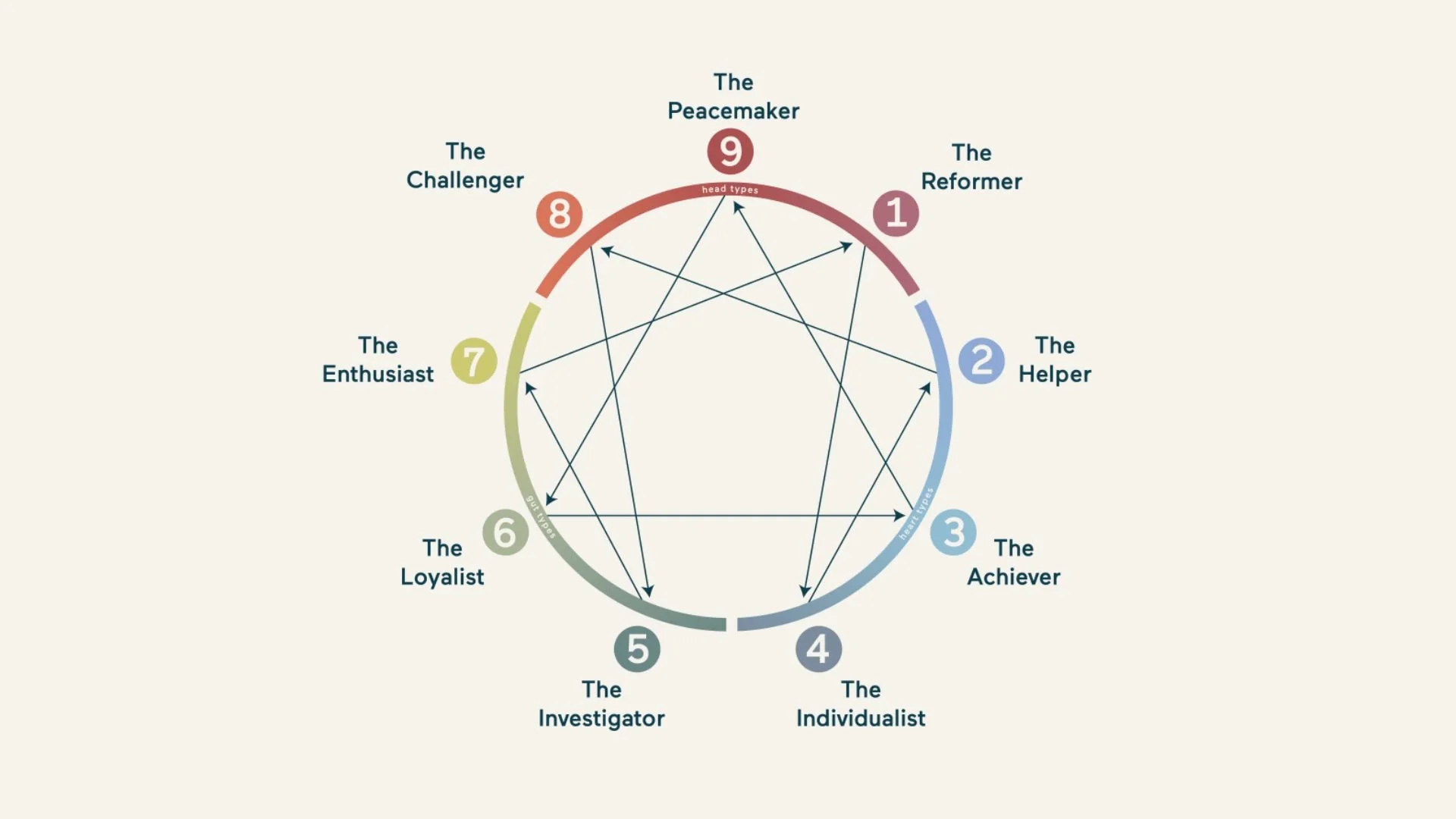
At its heart, the Enneagram is not a box that contains you.
It’s a map that helps you understand the box you’re already in—and guides you toward the door.
A Roadmap for Personal and Spiritual Growth
The Enneagram reveals what usually stays hidden: the automatic strategies we developed long before we consciously chose anything.
These strategies shape:
our habits
our relationships
our reactions
our avoidances
our longings
our impulses around food, movement, and self-care
When we begin to recognize these patterns with compassion rather than judgment, something shifts. We become less reactive. We take things less personally. We make choices from a wider, calmer inner space.
And the coping strategies that once helped us survive—but now feel worn-out—slowly begin to loosen their grip.
How We Use the Enneagram in Nutrition Therapy
Karin began doing nutrition therapy in 1983. Very early on, she noticed something important:
Two people can receive the same guidance, but their ability to follow through varies dramatically.
Some leap into change.
Some freeze.
Some rebel.
Some collapse into shame.
Some intellectualize and never act.
Some try to do it perfectly and burn out.
Some forget what they want because they’re tuned into everyone else.
When she began using the Enneagram in her work, the pieces finally came together. Hannah began studying the Enneagram in 2018 and found the same thing: it helps connect the dots between “I know what to do” and “But I don’t do it.”
Understanding your type clarifies:
Why certain eating behaviors feel automatic
Why guilt or pressure intensifies your patterns
Why your body cues might feel muted or overwhelming
Why change either energizes or terrifies you
Why goals fall apart—or finally click
This knowledge doesn’t label you. It empowers you.
It helps you make changes in a way that supports—not fights—your internal wiring.

Where to Go Next
If the Enneagram is new to you, start with The Enneagram: What’s My Type? for an introduction to each of the nine types and how they show up in daily life.
If you already know your type and want to understand what it might have to do with food, read How the Enneagram Can Help You Understand Your Eating Patterns.
And if you’re interested in how personality can affect the process of learning to eat more intuitively, read Nourish Your Type: What Happens When the Enneagram Meets Intuitive Eating.
The Enneagram isn’t a prescription for how you should eat. It’s another way of understanding what you bring to eating—and why the same approach doesn’t work equally well for everyone.
Enneagram Resources
We recommend:
Wisdom of the Enneagram - a great book with which to get started, don't miss the end, which describes how to use the Enneagram for spiritual growth
The Enneagram Made Easy - a very easy, and fun, guide to the Enneagram, with cartoon drawings to take it all in. Their other books are also recommended, including one for parenting and typing kids.
The Enneagram in Love and Work - good introductions on each type, and an excellent section on how each of the types relates to each other in work and love relationships.
The Spiritual Dimension of the Enneagram: Nine Faces of the Soul - an in-depth and deep book focusing on spiritual growth and the Enneagram, recommended only after having a basic understanding of the Enneagram.
Also, visit the Enneagram Institute website for in-depth descriptions, tests, workshops and more. Also, the Enneagram School of Awakening, which is where Karin got much of her training, has online classes.


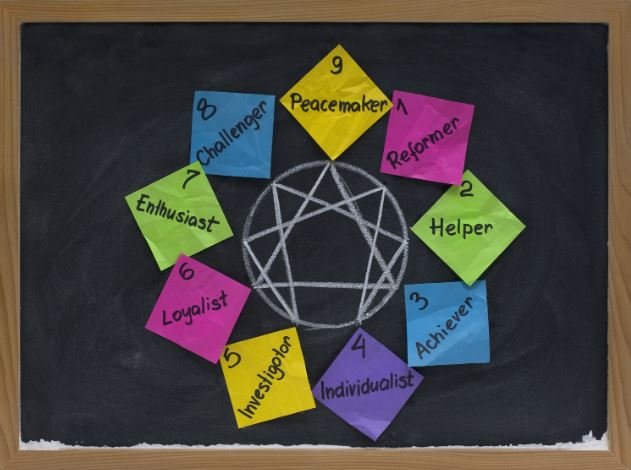

Learn how each Enneagram type experiences holiday triggers, stress, and eating patterns. Looks at navigating food, family, and seasonal pressures without diet culture.