
Holiday Eating Through the Enneagram Lens
The holidays can intensify everything that already makes eating complicated. There’s more food, more social pressure, more disrupted routines, more family dynamics—and often more diet talk layered on top of it all.
For someone learning to eat more intuitively, that can make it harder to stay connected to hunger, satisfaction, preference, and what the body actually needs.
But not everyone gets pulled off course in the same way.
The Enneagram can help explain why. Different personality patterns bring different vulnerabilities to holiday eating: perfectionism, people-pleasing, anxiety, resistance, distraction, emotional intensity, or simply losing track of yourself in the middle of everything going on.
Understanding your own pattern doesn’t tell you exactly how you should eat. It gives you another way to notice what may be pulling you away from yourself—and what might help you come back.
If you are new to the Enneagram, and curious about which personality type you might be, you can read about the different types here.
A Note About Enneagram Nuance
These type descriptions are meant as starting points, not fixed portraits. People of the same Enneagram type can look very different from one another, and the same underlying pattern can show up in very different behaviors.
Life experience, stress, self-awareness, and other aspects of personality all influence how a type is expressed. So rather than asking, “Does my type always do this?” it may be more useful to ask, “Do I recognize any part of this pattern in myself?”
Type 1 – The Reformer / Perfectionist
Holiday Pattern: May approach holiday meals with a clear sense of how things should go—what’s “healthy,” what’s “right,” and what counts as being disciplined. Can slip into rigid food rules or perfectionistic cooking standards. Guilt can be a constant companion as they analyze their food intake with eating tied to feeling good, responsible, or in control. (While this is true for many people with eating issues, it is often more intense for this type.)
Trap: Leaning on rules to feel virtuous or steady.
What softens the pattern: Notice when your mind starts grading the experience—your choices, the table, even the crumbs on the counter. A little mess doesn’t mean anything about you. It’s just life happening. The holidays can become a quiet invitation to let things be slightly imperfect and still okay. Pause before you eat. Feel your feet on the floor. Let your breath settle. This small shift back into your body can help you sense a deeper kind of “rightness”—not the outer rules, but the inner steadiness that comes from presence. Give yourself permission to enjoy without a scorecard. Taste joy. Let a little mess be okay.
Type 2 – The Helper / Giver
Holiday Pattern: Often focused on feeding others—making the perfect dish, tending to everyone’s comfort, noticing every need. In the swirl of caretaking, their own hunger becomes unimportant. They may eat only once the work is done or eat in secret while cleaning the dishes. If they feel unappreciated or unseen, eating may be an attempt to ease that pain.
Trap: Offering nourishment while quietly going without.
What softens the pattern: Let the holidays be a time to practice receiving. Sit down with others and allow yourself to be served. Eat slowly and savor the taste of the food, notice any tendency to want to rush through to help others or to get to the next need you anticipate. Also, in slowing down, notice your own hunger the way you notice everyone else’s. Let yourself be fed—by food, by company, by appreciation that doesn’t have to be earned. Your needs aren’t an interruption; they’re part of the gathering. Let caring for yourself be one of the ways you share love this season. Let receiving be as sacred as giving. Your hunger matters.
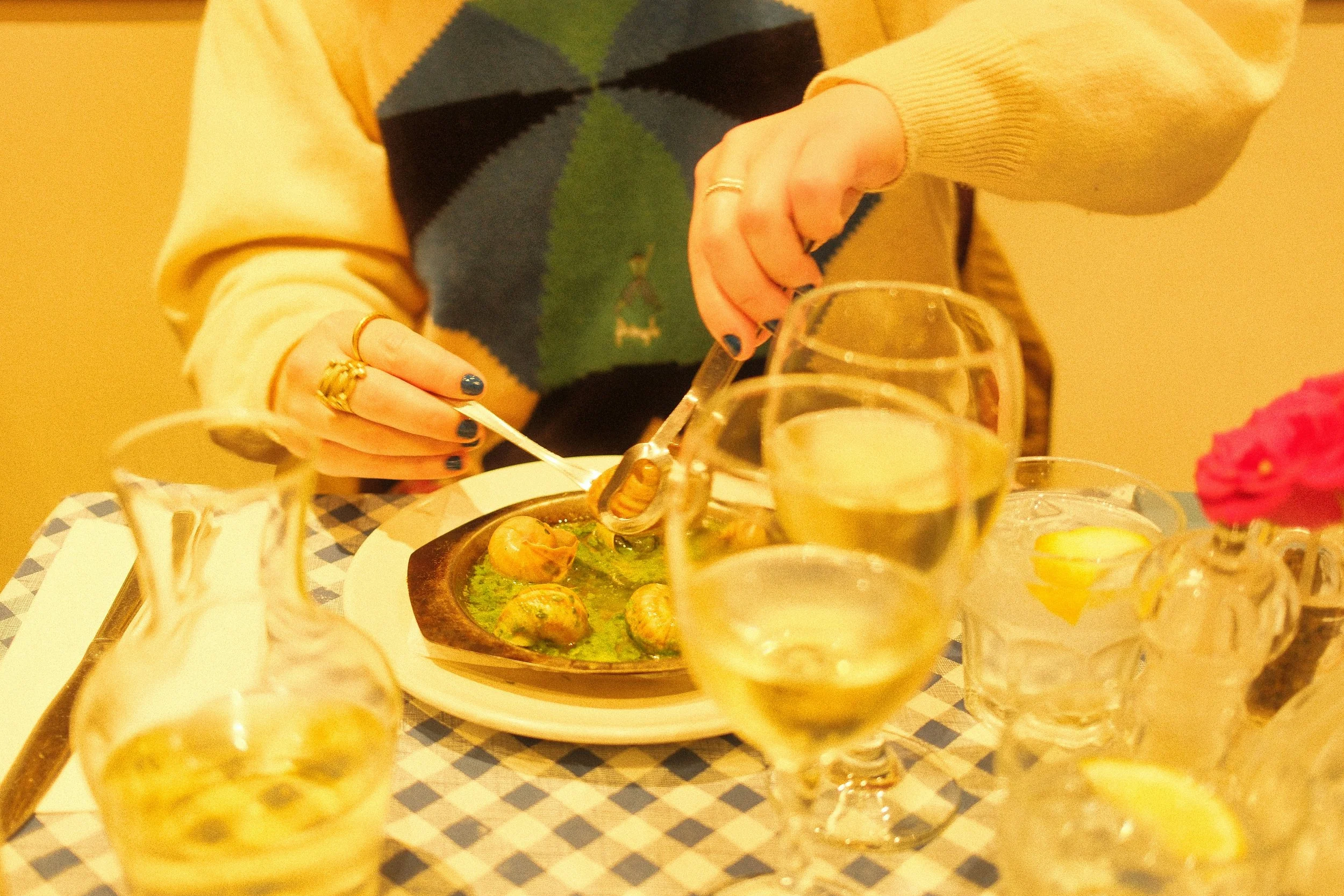
After searching through more than a hundred stock photos for “women being served food,” I found none. Women serving others? Everywhere. That alone says a lot about the roles our culture teaches women to occupy.
And for an Enneagram Two—someone already wired to meet others’ needs first—that’s a double whammy: the internal pull to give and the external expectation to keep giving.
So this Thanksgiving, try the opposite.
Let yourself receive. Be served. Be nourished. Be deliciously rebellious.
Type 3 – The Achiever / Performer
Holiday Pattern: May move through the season with an eye on appearances—how they look, how they’re eating, how they appear to others. Might focus on staying on track with food and exercise, plan compensations for indulgences, and use this focus to avoid feelings and appear composed. Food can subtly become part of maintaining an image, a way of staying in control when the pace of the holidays feels chaotic or when feelings threaten to arise.
Trap: Treating the body as a performance and eating as part of the presentation.
What softens the pattern: Before you fill your plate, pause for just a moment. Feel the weight of the utensil in your hand, the warmth rising from the food. This simple act interrupts the automatic reach for what “looks good” and invites you into what’s real. Stop and listen inward. Notice how hungry you are, take a second to rate your hunger on the Hunger Fullness Scale. Notice the sense of yourself in your body. Now, gently pull your energy towards your back. What happens? Just being present is enough. Let the food ground you—its temperature, its texture, its aroma. Let it remind you that you are you, you are enough, and you do not need confirmation from those around you. Belonging comes from showing up as yourself, not from eating a certain way, or looking a certain way. Let this meal be a small practice in presence.
Type 4 – The Individualist / Romantic
Holiday Pattern: The season can stir both nostalgia and ache. Food may have special meaning: the dish that reminds you of what you miss, the flavor that evokes a feeling you can’t quite name. You might eat to amplify emotion, or lose your appetite when feeling too much. Feelings can distract you from noticing what is real and in the moment, from connecting with others, from experiencing depth with others. The holiday table can feel like a mirror reflecting what isn’t there.
Trap: Covering up hunger and fullness with a whirl of emotion until it becomes hard to tell what you actually need.
What softens the pattern: Before you eat, listen inward. Allow yourself to slip past the whirl of emotion. Place your tongue softly against your palate next to your front teeth. Notice what happens inside. Check in to see how hungry you feel; then, allow the mind to provide some grounded insight. This tiny moment helps separate the emotion from your body’s sense of hunger—not to diminish your depth, but to give it space. You don’t have to feel everything intensely for it to be real. Let the food meet you where you are. A simple bite can offer steadiness. Let yourself taste what’s here, in this moment, and let it be good enough. These small acts can be a doorway back to yourself. Instead of being swept up by emotions, notice how each bite can provide real grounding and nourishment.

Type 5 – The Investigator / Observer
Holiday Pattern: Gatherings can feel draining—too many people wanting to talk, too much stimulation, too many expectations. In the overwhelm, eating can become an afterthought, with meals delayed, skipped, or eaten mechanically. When the body’s needs feel like just another demand, it can feel easier to retreat into the mind, where things seem quiet, contained, and manageable.
Trap: Disconnection from body to preserve mental space.
What softens the pattern: During the holidays, begin to notice when you recede. Does the noise in the room feel too loud? Is someone asking too many questions? Notice what happens to your awareness of hunger. Does it slip away? Know that when you are disconnected from hunger, you will also be disconnected from fullness—without the guidance that makes it easier to stop eating. With curiosity, see if you can track hunger leaving.
Type 6 – The Loyalist / Guardian
Holiday Pattern: Often anxious about food—planning meals, checking nutrition information, determining how to meet goals. Perhaps watching others for clues about what’s “okay.” Eating during the holidays can feel especially confusing in a world that preaches discipline, monitoring and control, while at the same time encouraging indulgence, letting go, and eating whatever. But what is okay? In the uncertainty, food rules can become a lifeline. They may be so normal in your life, you don’t notice them operating in the background.
Trap: Using rules or worry to create a sense of safety.
What softens the pattern: Before you get to the holiday meal, allow yourself to watch your food rules. Be curious if they become louder or more rigid. If so, notice what is happening inside you—perhaps you are also feeling more tense or unsettled. Perhaps you are frustrated. Pause. Gently place your tongue where your palate meets your teeth and exhale slowly a few times. See if anything softens or steadies in you. This small practice helps you sense support from the inside rather than reaching for it through rule-following. Your body already holds a kind of inner ground. You may discover you can trust that steadiness more than the shifting rules around you.

Type 7 – The Enthusiast / Adventurer
Holiday Pattern: May anticipate the feast as much as the food—wanting to taste everything, experience everything, and make the most of it all. May eat quickly or keep sampling new things to stay lifted, to avoid boredom, or to outrun feelings that threaten to dim the moment. With all the holiday overwhelm, you may find yourself moving from bite to bite, room to room, without fully landing anywhere. Stress can also shift you into your Type 1 (one of your Resource Points), which can make you hypercritical of others and of yourself, judging what is on the table and the conversations happening around it. In this space, you might deny yourself the plate you actually want and instead chug a protein chai, criticizing the meal for not being up to a particular standard.
Trap: Using distraction (good or bad) or constant “nextness” to avoid stillness, especially when something tender or heavy edges into awareness.
What softens the pattern: Notice the moment your attention leaps ahead—to the next flavor, the next story, the next bright thing, or—if you’re feeling critical—to what you’re judging. Allow yourself to shift into a moment of presence, to arrive more fully where you already are. Take one conscious taste. Let a single bite register—its texture, its warmth, its sweetness. Often that tiny moment of contact is enough to open the door back into presence. Pleasure deepens when you stay with it long enough to actually feel it. The real feast isn’t in more options; it’s in the delight that unfolds when you let one moment land inside you.
Type 8 – The Challenger / Protector
Holiday Pattern: Holidays seem like a great opportunity to amplify the tendency to go big—with presence, with energy, with food. May eat quickly or in large amounts, taking big bites, without fully noticing the food or what you are doing, driven more by momentum than by appetite. The intensity of the season can entice you into “more”—more flavor, more volume. More of whatever. May do this less as an indulgence, but more as a way to stay connected to a sense of aliveness. But, you may be less aware of internal signals, such as the subtle cues of fullness, especially if emotions feel complicated or the environment feels intrusive.
Trap: Mistaking intensity for groundedness—using fullness, speed, or sheer force to stay in control while drifting further from your own needs.
What softens the pattern: In the excitement of holiday energy, notice the moment you shift into intensity around food and eating—the quick reach, the big bite, the instinct to power through the meal. Rather than trying to stop it, sense into what’s underneath. Often there’s a desire to feel anchored, alive, unmistakably here. See what happens if you let yourself register one aspect of your eating: the weight of the fork in your hand, the warmth of the food as you chew, the first taste of a new food on your plate. These small points of contact don’t diminish who you are—your aliveness; rather, they help you inhabit it. Sometimes the most grounded version of you arrives not through more, but through noticing. Let the meal meet you without needing to conquer it. Let the moment land in you.

Type 9 – The Peacemaker / Mediator
Holiday Pattern: Tendency to lose touch with yourself can be heightened during the intensity of the holidays. May be more likely to go along with what others want, lose track of own preferences, or eat mindlessly just to stay easygoing and blend in. Can “go along” and not be aware of how hungry you are, or how full you are getting. If conflict, noise, or tension arise, food can become a distraction. A way to slip into the background—to soothe, to dull, or to disappear a little.
Trap: Drifting away from hunger and desire in the name of keeping peace.
What softens the pattern: In the hectic times of the holidays, find a moment to attend to your wants, to notice them. The holidays can become a gift you give yourself—a chance to practice presence. Before you take a bite, pause just long enough to notice if you’re choosing what you actually want or simply following the flow around you. You don’t need to change what you are doing, or what you are eating. Just that small moment of noticing—What do I like? What do I need right now?—is an act of returning home to yourself. Let the season’s focus on giving and connection include you. Your presence, your preferences, and your appetite all deserve a place at the table.
As You Head Into the Holidays
Holidays can magnify our patterns around food, and cause no end of angst. Intuitive eating and the Enneagram can help free you from being stuck in those patterns, and become a path towards more joy and peacefulness during the season.
Be curious as you watch your patterns. Give yourself some leeway knowing that holidays can be difficult. And know that intuitive eating is not about perfect choices. Rather, it’s about being kind and compassionate with yourself, especially during hectic times that pull you in different directions.
May this holiday season offer you moments of nourishment for body, heart, and soul.
Keep Exploring
If you’re new to the Enneagram or still figuring out your type, start with The Enneagram: What’s My Type?.
To explore how Enneagram patterns can show up around food and eating, read How the Enneagram Can Help You Understand Your Eating Patterns.
You can also explore the other Enneagram articles on Eating Wisdom for a deeper look at individual types, intuitive eating, and how personality patterns show up in everyday life.


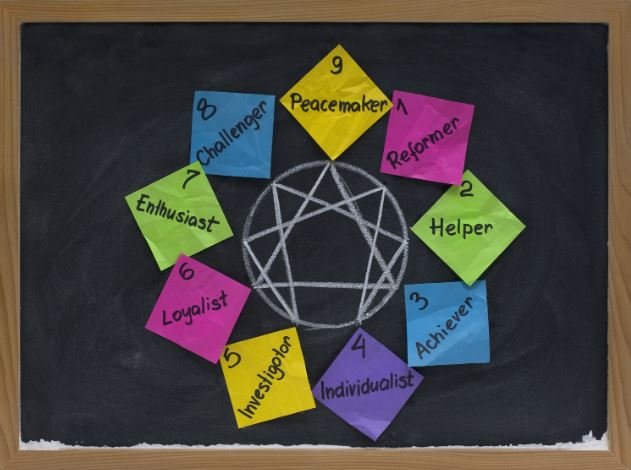


Learn how each Enneagram type experiences holiday triggers, stress, and eating patterns. Looks at navigating food, family, and seasonal pressures without diet culture.